Headline: Scalable Memory System Boosts Real-Time Resource Tracking for Faster, Safer Data Management Alternative industry-specific option: Next-Gen Memory Architecture Streamlines Priority Access and Process Tracking in Data Centers
Invented by KIRK; Aaron, PANAVICH; Jason, ARORA; Vikram

Today, computers and processors must handle more tasks than ever before, all at lightning speed. One way they do this is by making sure different tasks do not bump into each other when using the same memory. Let’s explore a new technology that helps processors keep everything in order with less effort. In this article, you’ll see why this matters, how the science behind it works, and what makes this invention special. Let’s jump in!
Background and Market Context
Imagine your kitchen on a busy morning. Everyone wants to use the toaster, the microwave, and the fridge at the same time. If people do not wait their turn or if two people try to use the toaster at once, chaos breaks out. Processors inside computers face a similar challenge. They need to let many instructions use the same memory or other resources, but only one at a time, or they risk mixing things up and getting wrong answers.
Over the years, processors have become much faster and smarter. They run several instructions at the same time to save time. But, when more than one instruction tries to use the same piece of memory, they can clash. This is called a “memory hazard.” A memory hazard is a problem that happens when two or more instructions try to use the same data or memory at the same time. If the processor does not control these actions, it may end up with mistakes or wrong results.
Traditionally, to keep things in order, computers use a special structure called a “linked list.” Think of a linked list as a line where each person holds the hand of the next person. This line helps the processor know who goes first, second, and so on. If someone leaves, the line simply closes the gap.
As processors have gotten faster and can handle more instructions at once, the need for better ways to manage these lines (linked lists) has grown. The old way often needs a lot of extra work and hardware, making computers slower and more expensive. This is where the new invention comes in. It aims to keep everything neat and orderly, but with less effort and cost.
Today’s market is full of devices that depend on quick, error-free memory use. Smartphones, laptops, servers, and even cars all rely on processors that can juggle many tasks at once. Businesses want computers that are both fast and reliable, without needing lots of extra hardware. So, there is a big need for smarter, more efficient ways to manage memory use and avoid hazards.
This invention offers a way to keep track of which instruction should use a memory spot next, just like a well-organized line in a busy kitchen. By making this line using special memory entries that can find information quickly (content-addressable), processors can work faster and with less hassle.
Scientific Rationale and Prior Art

To understand why this invention matters, let’s look at how things were done before. Processors usually use memory structures like static random access memory (SRAM) to keep track of which instruction is using which piece of memory. However, these memory types need an extra control circuit to tell them where to look or write. This can make things slow, especially when many instructions are in the pipeline and want to use the same memory.
Linked lists help organize instructions by linking them together, one after another. Each instruction holds a pointer to the next one, like a chain. This works well, but the linking and searching can be slow if the system is big. Also, adding or removing instructions from the list needs extra steps and hardware, which can make the processor more complicated and less efficient.
Content-addressable memory (CAM) is a different kind of memory. Instead of looking for something by its address (like a house number), CAM can search for a value directly, like asking “Who has the blue hat?” and instantly finding the answer. This is much faster for certain tasks, especially when you need to search for a match among many entries. However, building a linked list with CAM has not been common, because linking entries and updating them as instructions come and go can be tricky.
Before this invention, handling multiple instructions that want to use the same memory spot required either:
1. Building complex random-access memory systems with lots of extra control logic;
2. Using software-based solutions, which are flexible but much slower;
3. Accepting slower performance and more hardware to ensure correctness.
None of these solutions were perfect. They either slowed things down, used too much hardware, or both. The challenge has always been to create a system that is both fast and simple, so processors can keep up with today’s demands without getting bogged down by complexity or cost.
The scientific reason for using content-addressable entries in a linked list comes from the need to rapidly find and update entries. When an instruction wants to use a memory spot, the system must check if that spot is already being used, add the new instruction to the line if needed, and remove it when done. Doing all this quickly, in parallel, and with little overhead is the main motivation behind this invention.
Invention Description and Key Innovations
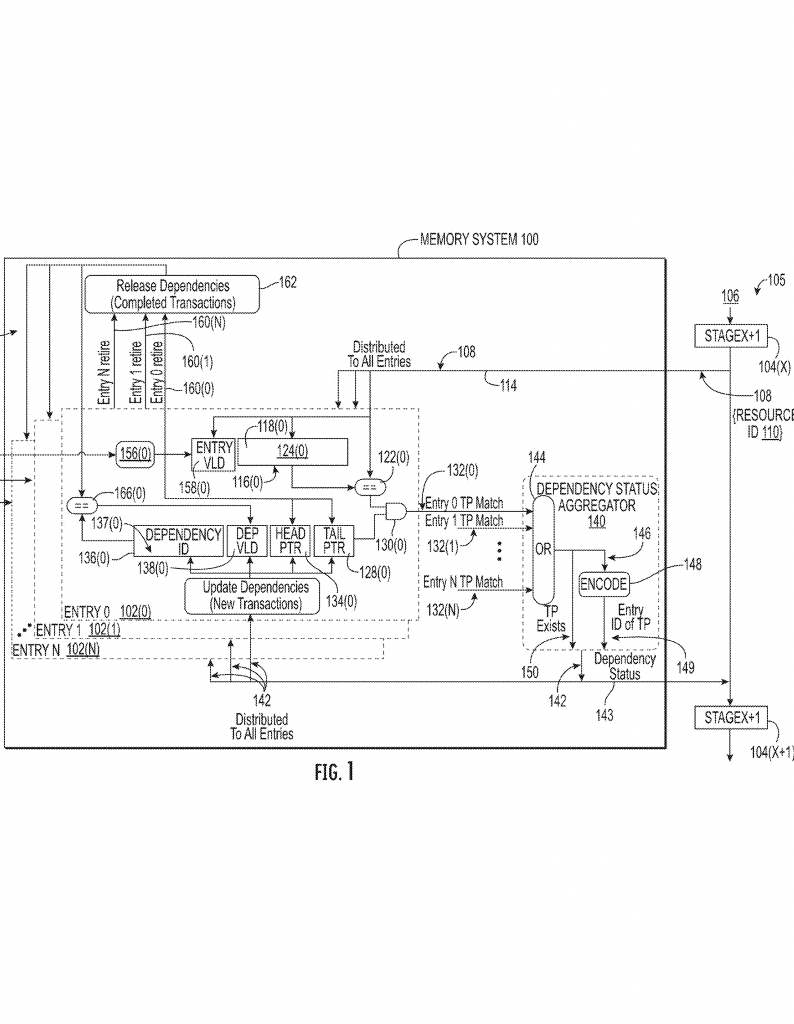
This invention introduces a memory system that does three big things: it keeps track of which instruction is using which memory spot, makes it easy to add or remove instructions from the list, and does it all quickly using content-addressable entries. Let’s break down how it works in a way that is easy to follow.
The heart of the invention is a group of memory entries called “content-addressable entries.” Each entry can store information about an instruction and which resource (like a memory address) it wants to use. When a new instruction comes in, all entries can check at the same time if they are already using that resource. This is like everyone in a classroom raising their hand at once if their name is called.
If no one is using the resource, a new entry is created and becomes both the start and end (head and tail) of a new line (linked list). If someone is already using it, the new instruction is added to the end of the line, and the entries update themselves so the order is kept right. Once an instruction finishes using the resource, it leaves the line, and the next one moves up.
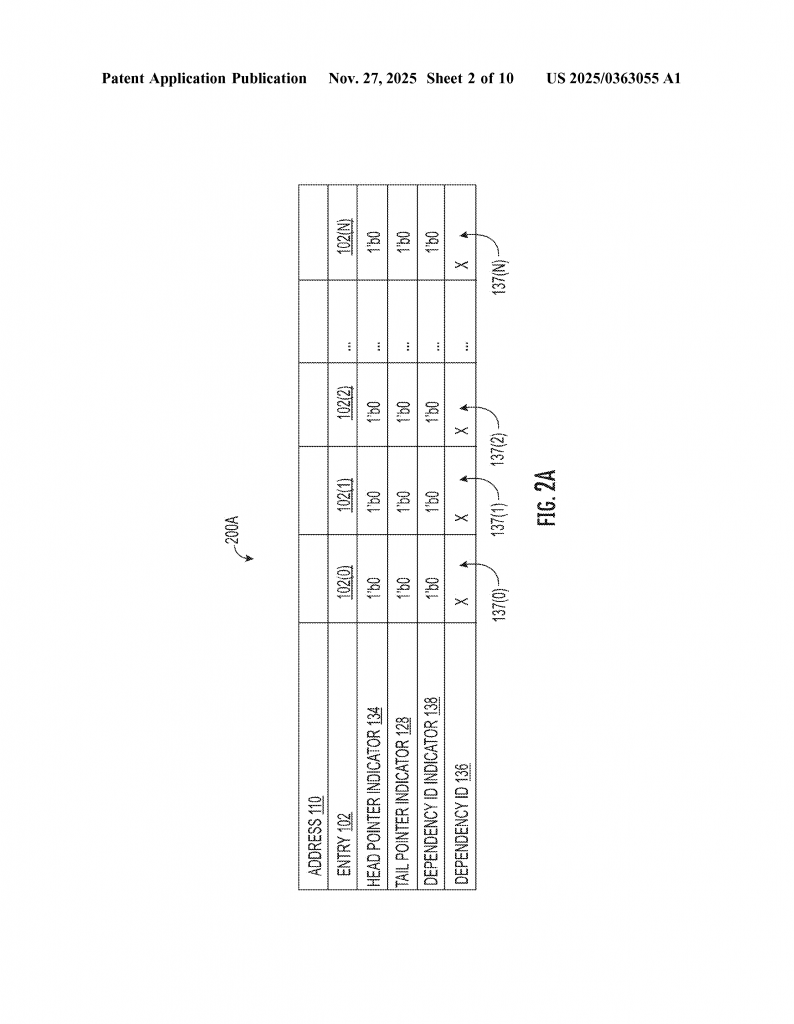
Each content-addressable entry has several small registers:
– A spot to store the resource ID (which memory spot it wants to use);
– A flag to say if it is the start of the line (head);
– A flag to say if it is the end of the line (tail);
– A pointer showing which entry it depends on (like holding the hand of the person in front).
Let’s see how this works step by step:
1. Establishing a New Entry:
When a new instruction comes in, the system asks, “Is there already a line for this memory spot?” All entries check at the same time. If there is no line, the new entry becomes both the head and tail. If there is already a line, the new entry is linked to the end.
2. Updating the List:
When a new entry is added, it sets its dependency pointer to the previous tail, and the old tail updates itself to show it’s no longer at the end. This keeps the line straight and in the right order.
3. Retiring an Entry:
When an instruction finishes, the system removes the head of the line. The next entry updates itself to become the new head. This is done automatically by checking pointers and flags, so everything stays in order.
4. Parallel Operation:
All entries can check and update themselves at the same time. This means the system works very quickly, without waiting for each step to finish before starting the next. It is like having many helpers who all know what to do at the same time.
5. Scalability:
If you need more entries, you can simply add more. Each entry only needs a few small registers and a simple logic circuit. This makes the system easy to grow without adding lots of extra complexity or cost.
The invention also has circuits that help keep track of who is at the head or tail of each list, and can combine signals from all entries to make decisions quickly. There are also ways to handle cases where updates might be a little slow, by keeping track of what needs to change and making sure no steps are missed.
This system does not need an extra memory control circuit to look up entries by address, which is what slows down other systems. Instead, it relies on the content-addressable nature of the entries to find matches instantly. This saves time and hardware, making the whole processor work better.
Some extra features include:
– The ability to handle several resources at once, each with its own line;
– The ability to add urgent instructions to the front of a line if needed;
– The ability to retire entries and fix up the list in the same step;
– The option to track which stage of processing each instruction is in, to help with timing.
Finally, the system is designed so that its size and speed can be tuned for different processors, from small chips in gadgets to big ones in servers. It works well with other parts of the processor, like instruction pipelines and caches, and can be built using standard hardware or as software running on a computer.
Conclusion
In today’s fast-paced world, processors need to handle more tasks in less time, all without making mistakes. This invention gives them a smarter way to keep track of which instruction should use a memory spot next, using simple, fast, and scalable content-addressable linked lists. By letting all entries work together at the same time, and by keeping lines neat and easy to update, this memory system helps processors run faster and more reliably, with less hardware and effort.
If you are building or choosing technology for anything from smartphones to servers, this invention could help make your systems quicker, safer, and more cost-effective. It is a big step forward in how computers manage memory and avoid hazards, all without making things more complicated than they need to be.
Click here https://ppubs.uspto.gov/pubwebapp/ and search 20250363055.