AI System That Learns, Adapts, and Remembers—Boosting Long-Term Business Intelligence
Invented by Galvin; Brian
This article breaks down a new patent about making computer neural networks smarter. It covers why this invention matters, how it builds on existing technology, and what makes it so original. If you want to understand how computers can remember, learn, and even “rest” like humans, keep reading.
Background and Market Context
Artificial intelligence (AI) is changing how we live and work. From voice assistants to self-driving cars, AI systems use neural networks to find patterns and solve problems. These networks are made of many small units (like brain cells) connected in layers. They learn by changing the strength of those connections.
But even the best neural networks today have some big problems. First, they forget almost everything when turned off. Imagine having to relearn your name every time you woke up! Most neural networks lose all their “memory” unless someone saves their weights and settings. Even then, bringing them back to life means a long, slow process.
Another issue is that these systems can’t really improve themselves while they are resting. In nature, brains use sleep to organize memories, get rid of useless connections, and discover new ideas. Computers, however, only get better during special training sessions. They can’t learn from their own experience during “downtime.”
Most neural networks are also rigid. Their structure rarely changes while they run. If a part of the network is not needed, it just sits there, wasting resources. Removing or adding parts usually happens after training, not in real time. Plus, most systems have only simple oversight—they don’t have layered supervisors guiding their growth and changes.
Industries like robotics, healthcare, finance, and manufacturing need smarter and more flexible AI. They want systems that can preserve what they have learned, adapt on the fly, and run more efficiently. This patent answers that need by introducing a neural network that can remember, learn during sleep, and change itself while staying stable.
Scientific Rationale and Prior Art
To understand why this invention is important, let’s look at how neural networks and related ideas have developed.
Traditional neural networks are inspired by the human brain. They process information through layers of “neurons,” adjusting strengths (weights) as they learn. But their memory is not like a brain’s. When powered off, a regular neural network loses its state. To restore it, engineers have to reload saved weights, reinitialize settings, and sometimes retrain parts of the network. This is slow and can even break the learning process.
Some systems try to solve this with check-pointing (saving states at intervals) and model serialization (saving the model as a file). These help, but they aren’t true persistent memory. They don’t capture the state of all the neurons and their activity patterns. Also, they don’t handle the “context”—the bigger picture of what the network was doing or learning at the time.
When it comes to learning during rest, biology gives us clues. Brains use sleep for memory consolidation, pruning, and creativity. Some research in AI has added “sleep phases” to help networks remember better or prune unused connections. But these are usually basic, offline processes, not real-time, multi-level operations. Few AI systems can optimize themselves during sleep without stopping their main work.
There are already some ways to adapt a neural network’s structure. Pruning removes parts of the network that aren’t used much, making the system faster and less resource-hungry. But most pruning is done by engineers, not by the network itself, and rarely during normal operation. Dynamic neural networks that grow or shrink in real time are rare, and those that do exist usually lack the oversight to stay stable as they change.
Supervision in neural networks is basic, too. Some architectures use simple controllers or “attention heads” to guide learning, but these are not layered or hierarchical. They can’t make high-level decisions about how to change the network’s architecture or manage resources across different parts of the system.
In summary, while lots of pieces exist—like checkpointing, pruning, and supervisory controllers—no one has put them all together into a persistent, self-optimizing neural system with multi-level oversight and sleep-state learning. This patent does just that, drawing from biology and computer science to create a system that is both smart and stable.
Invention Description and Key Innovations
This invention is a computer system designed to make neural networks smarter, more reliable, and more independent. It introduces several new components that work together to create a “persistent cognitive neural architecture.” Here’s how it works and why it’s special.
1. Persistent Neural State
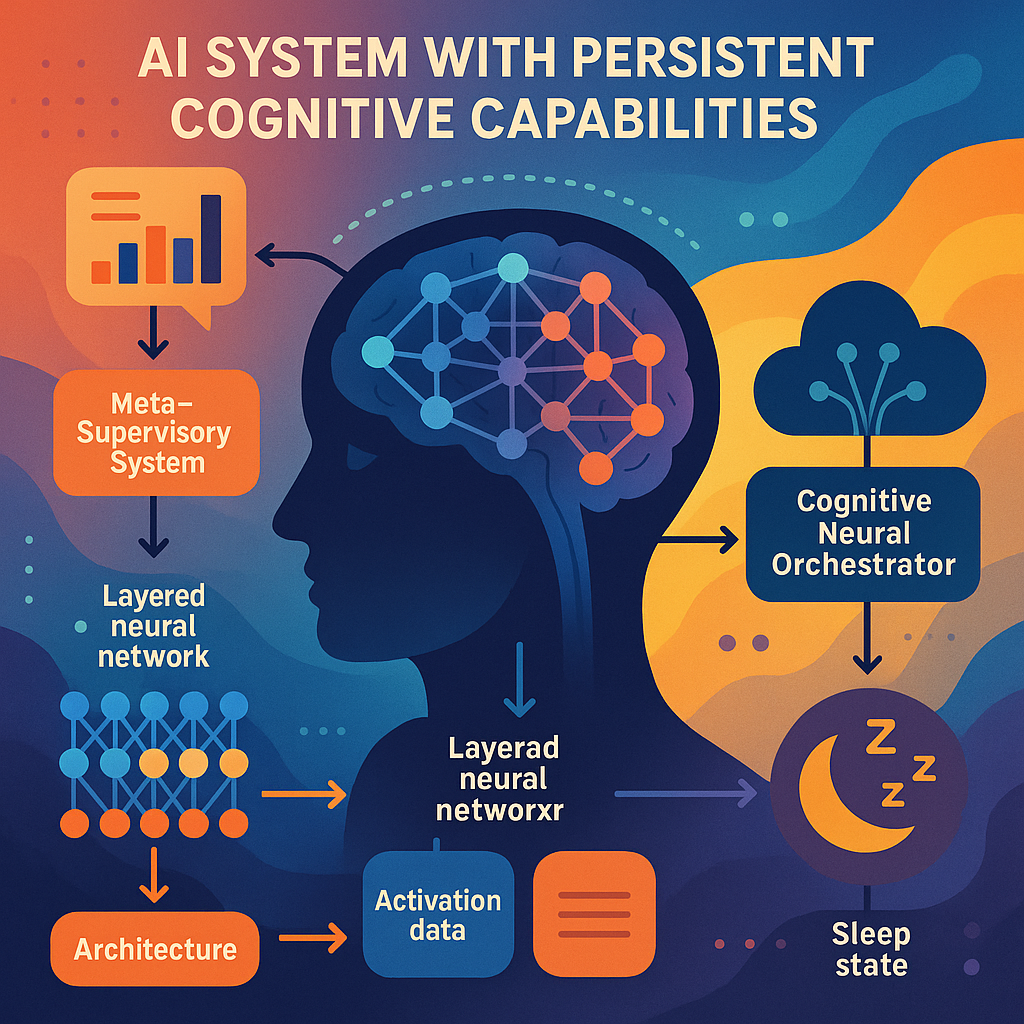
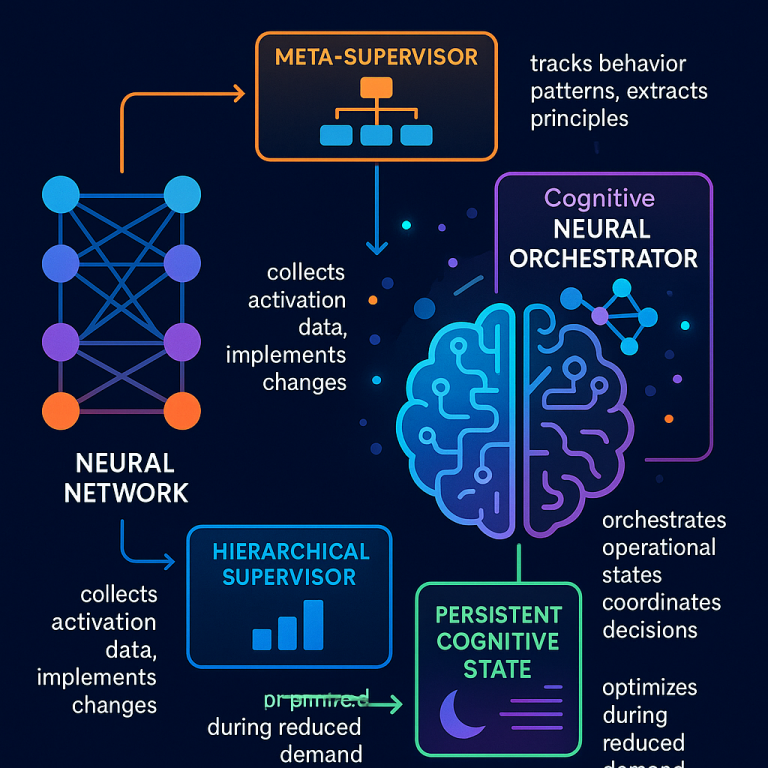
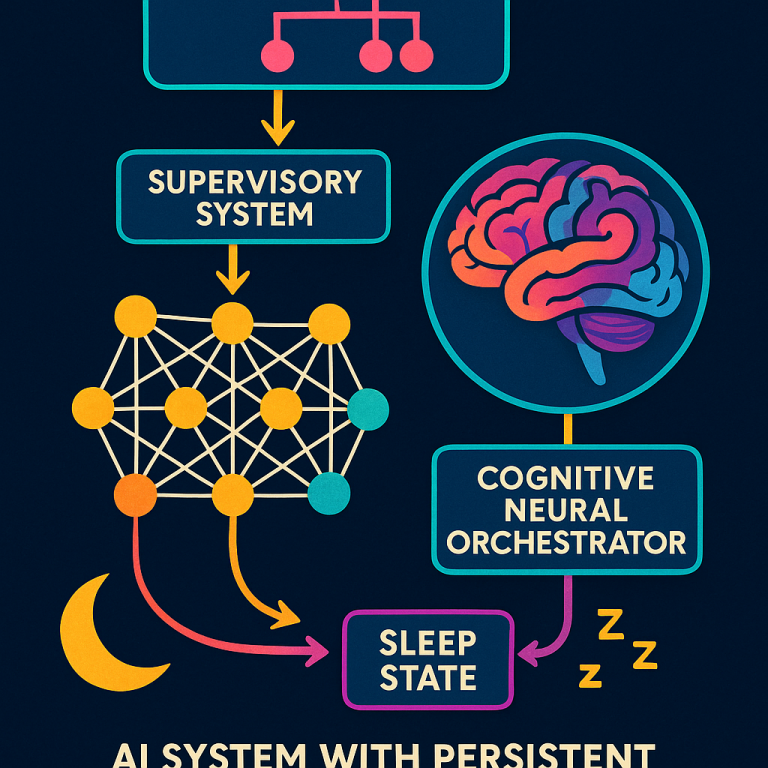
The system can capture and store the complete state of a neural network, including all activation patterns, connection strengths, and architectural settings. This means that after shutdown or restart, the network can pick up exactly where it left off—like a brain waking from sleep. The state is saved using smart serialization and can be restored step by step, ensuring nothing is lost or corrupted.
2. Hierarchical Supervisory System
Instead of one simple controller, this system uses a hierarchy of supervisors. At the lowest level, supervisors monitor small groups of neurons. Mid-level supervisors watch over groups of these, and high-level supervisors oversee the whole network. Each level collects data, finds patterns, detects unused parts, and decides when to make changes. They talk to each other, sharing information about network activity and resources, so decisions are coordinated and safe.
3. Meta-Supervisory System
Above the hierarchy is a meta-supervisor. This “boss of the bosses” tracks how the supervisors behave, remembers which changes worked well, and finds general rules for making the network better. It keeps the whole system stable while allowing it to learn from its own experience.
4. Cognitive Neural Orchestrator
The orchestrator is like the conductor of an orchestra. It manages the network’s state, deciding when to be active, when to observe, when to think independently, and when to rest (sleep). It coordinates all decisions about resource use, process scheduling, and state transitions. When it’s time for the system to rest, the orchestrator makes sure all parts are ready and that the sleep state will be productive.
5. Sleep State and Optimization
During periods of low demand, the network enters a special sleep state. This is more than just shutting down; it’s a time for deep optimization. Several key processes happen during sleep:
– Memory Consolidation: The network reviews its connections, finds the most important ones, and strengthens them—just like humans remembering what matters most.
– Insight Generation: The system looks for hidden links between distant parts of the network, proposing new direct connections (bundles) between regions that often work together.
– Pruning: Unused or weak connections are identified and removed, freeing up resources for more valuable tasks.
– Memory Reorganization: The network reorganizes its structure to improve efficiency, grouping related parts closer together and simplifying information flow.
These sleep operations are managed by a special subsystem that works with the rest of the architecture. Sleep scheduling is hierarchical, too; different parts of the network can sleep at different times or depths, ensuring essential functions are always available.
6. Signal Transmission Pathways (Bundles)
The system can create direct communication channels between distant regions of the network. These “bundles” allow quick sharing of information, bypassing intermediate layers and reducing delay. The system monitors which regions often work together and forms bundles as needed, coordinating their timing and signal strength.
7. Cross-Session and Cross-System Integration
The architecture includes tools to connect its own memory and learning processes with other systems. For example, it can integrate language models or reasoning engines, calibrating them to work well with the neural network. It can also share knowledge with other networks, transfer learning across domains, and adapt to new environments while keeping its core identity intact.
8. Safety and Stability
All changes, whether during sleep or active operation, are closely monitored for stability. If something goes wrong, the system can roll back to a previous stable state using checkpoints. Security checks and integrity tests ensure that the network doesn’t become corrupted or lose critical knowledge.
Why It Matters
Together, these innovations create a neural network that never truly “forgets,” that improves itself continuously, and that adapts in real time without losing stability. It can maintain knowledge across shutdowns and restarts, learn during downtime, and coordinate complex changes safely. This is a big step forward for AI systems that need to operate reliably in the real world, where interruptions, changing demands, and long-term learning are all part of the job.
Real-World Impact
A factory robot using this system could remember the best way to assemble new products, adapt when a part changes, and keep learning from its own experience—even after being powered off. A medical diagnostic tool could maintain and refine its knowledge over years, improving accuracy as it sees more cases and keeping up with new medical findings. Financial analysis systems could adapt to changing markets, remember what worked during past crises, and stay stable during system upgrades or interruptions.
This architecture also makes it easier for organizations to build smarter, more adaptive AI solutions that don’t require constant hand-holding from engineers. The network can learn, adapt, and optimize itself—much like a living brain.
Conclusion
The patent for persistent cognitive neural architecture with sleep state optimization brings together ideas from neuroscience and computer engineering. It solves real problems with memory, learning, and adaptability in AI. By combining persistent state, multi-level supervision, sleep-based optimization, and safe structural changes, this invention sets a new standard for smart, reliable neural networks. Whether in industry, healthcare, finance, or beyond, this technology can help create AI that remembers, adapts, and keeps getting better—with less effort and more trust from those who depend on it.
Click here https://ppubs.uspto.gov/pubwebapp/ and search 20250363367.