AI Platform Instantly Compares Multiple Pipelines for Faster Model Selection and Smarter Decisions
Invented by DeWesse; William, Fedoruk; Roman, Manton; John, Reagan; Spencer, Roberts; Gregory, Stuntebeck; Erich
Let’s explore a new patent application about testing and comparing AI pipelines. This idea is all about making it easier for people and companies to see how different AI setups work, how they differ, and which one works best for them. We’ll walk through the market background, scientific reasons, previous solutions, and what’s new and special about this invention. By the end, you’ll know how this patent could change how we build and trust AI systems.
Background and Market Context
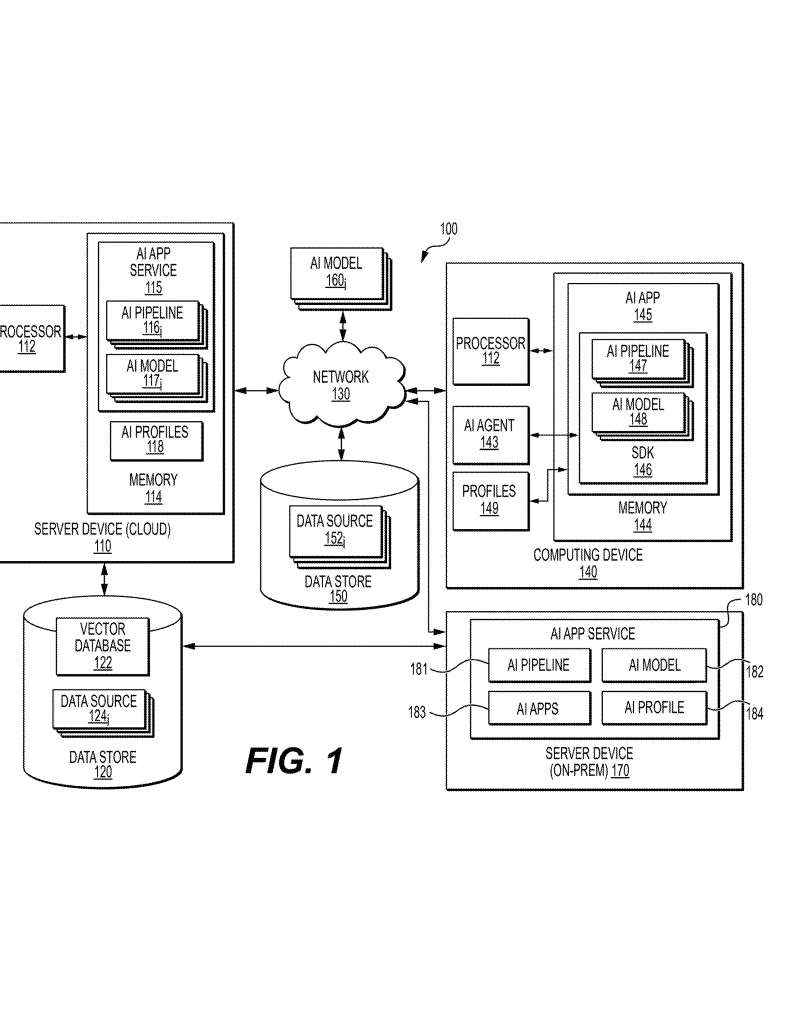
Artificial Intelligence (AI) is now part of almost every industry. From healthcare and finance to retail and education, businesses use AI to solve problems and make work faster and smarter. But building an AI solution isn’t simple. Companies usually create something called an AI pipeline. This pipeline is a string of steps that takes in data, processes it, and gives an answer or result. Each step might use different tools—like a language model, a set of rules, or a custom code.
Here’s where things get tough. The AI world moves quickly. New models come out all the time. Old ones get updates. Sometimes, the very same AI tool can behave differently if the company behind it changes something, like a hidden system prompt. If a business wants to try a new AI model, or swap out part of their pipeline to save money, they need to be sure the change won’t break their whole system. That’s not easy.
Testing new AI pipelines, or even just small changes, is hard. It takes time, needs lots of coding, and often, you can’t see if the changes really matter. Sometimes, the result looks different but means the same thing. Other times, a tiny change causes the whole system to go off track. If you can’t see those differences right away, you might give your users a confusing or even broken experience.
Companies also care about costs. Some AI tools are expensive, and not everyone can use the newest and best models all the time. Sometimes, using a cheaper tool is fine—if it gives similar results. But how do you know if it’s “similar enough”?
In short, businesses need a way to:
- Quickly test different AI setups side by side
- See when and how their results change
- Understand if those changes really matter
- Control costs and stay flexible
No simple, easy-to-use tool existed for this. Most solutions required lots of code, manual comparisons, or just trial and error. As AI becomes more important, the need for a better way to handle these problems is only getting bigger.
Scientific Rationale and Prior Art
Let’s look at how people have tried to solve these problems before, and why those ways haven’t been enough.
First, AI pipelines are made up of different parts: models (like GPT or BERT), datasets (collections of data), prompts (instructions for the model), and sometimes special code for extra steps. When you want to change something—like swap in a new model or tweak the prompts—you need to make sure the pipeline still works as expected. But every part can interact in tricky ways. For example, a prompt that worked with one model might not work the same with another. A dataset change might affect the output, too.
In the past, the main way to test these changes was to run each pipeline separately, collect the results, and then compare them by hand or with custom scripts. Sometimes, people used batch tests—feeding the same set of questions or data into each pipeline and comparing answers. But this was slow, not visual, and often missed subtle changes in meaning.
Some tools tried to help by giving more advanced analytics, but they didn’t show a side-by-side view in a single place. They also didn’t use smart ways to measure if results were “close enough” in meaning, not just in words. This is important, because AI models can say the same thing in different ways. If the meaning is the same, that’s usually good enough. But if the meaning changes, that can be a problem.
Another problem with older solutions is they didn’t keep track of changes over time. If an AI provider updated their model or changed a hidden setting, users might not even notice until something broke. There was no easy way to compare today’s results with last week’s or last month’s, especially if those tests weren’t saved.
Finally, many companies struggled with cost and compliance. They needed to know not just which pipeline worked best, but which one was fastest, cheapest, or met privacy rules. Some tools let you measure time or cost, but didn’t connect those numbers to the side-by-side results.
What was missing was a platform that could:
- Let users build, edit, and run different AI pipelines easily
- Show the pipelines and their results side by side in real time
- Use AI to measure if results are semantically (meaning-wise) similar
- Show where and when results start to differ
- Support comparing with historical runs to spot changes over time
- Track metrics like cost, speed, and resource use
This is the scientific gap the new patent tries to fill.
Invention Description and Key Innovations
This patent introduces a new system and method for testing AI pipelines against each other. It’s built around a user-friendly interface—a special screen where you can build, display, and run multiple AI pipelines at once. Here’s how it works, in simple terms.
1. Building and Displaying Pipelines Side by Side
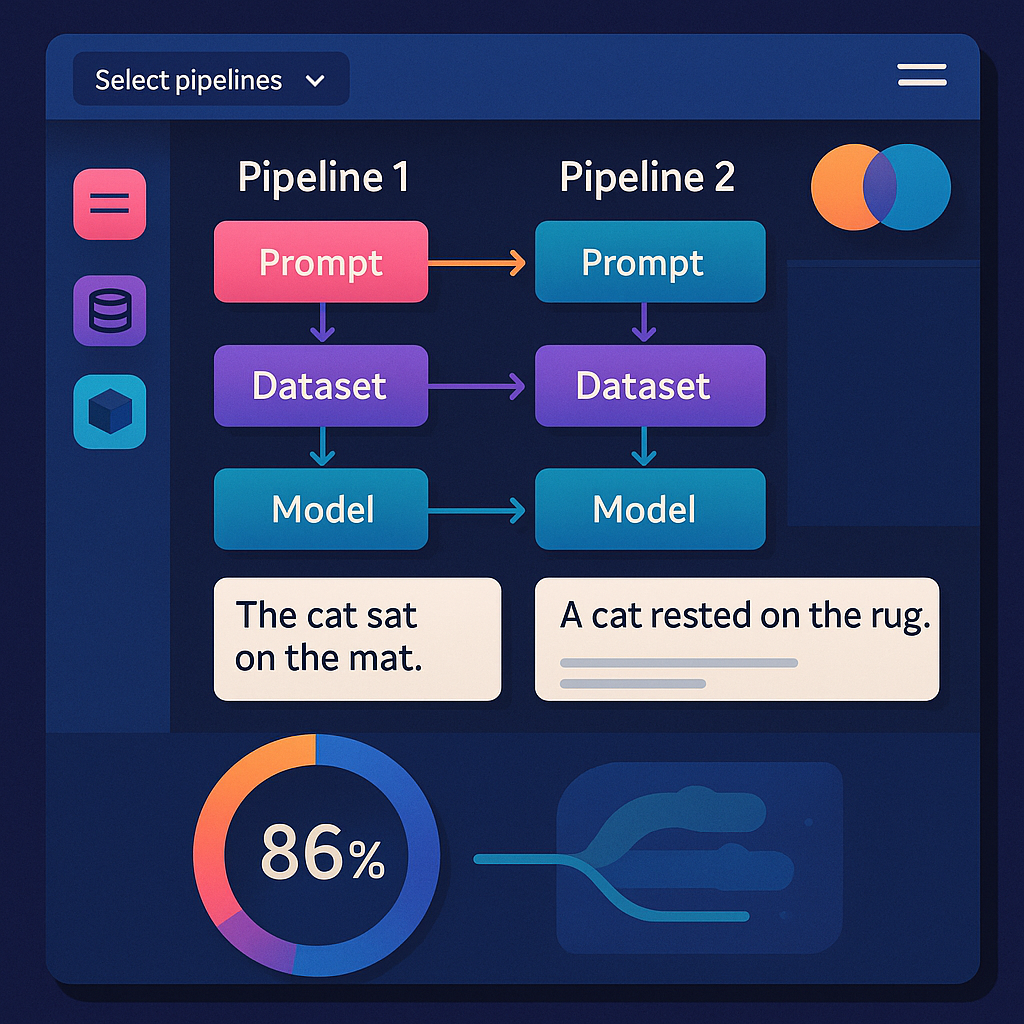
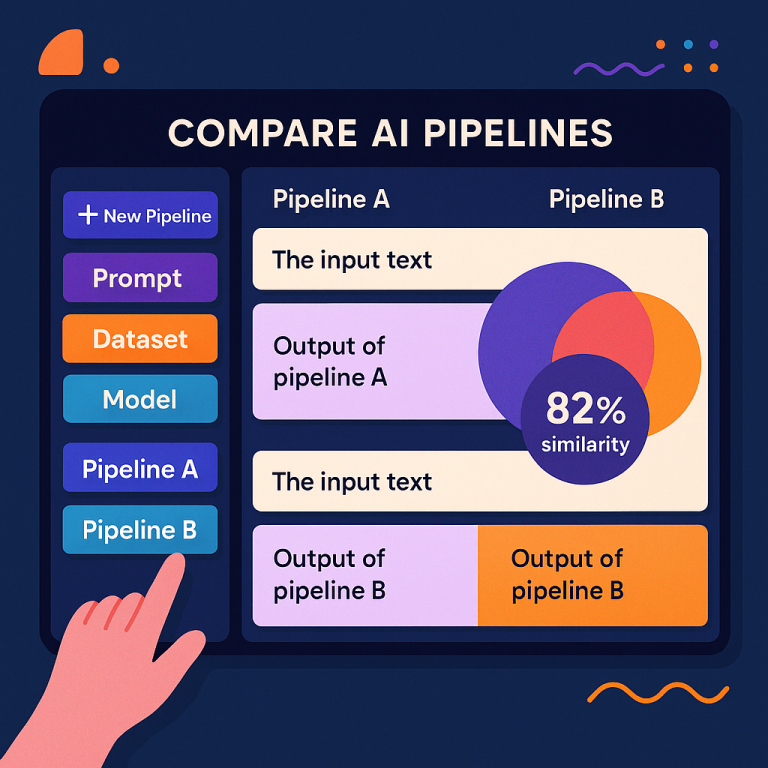
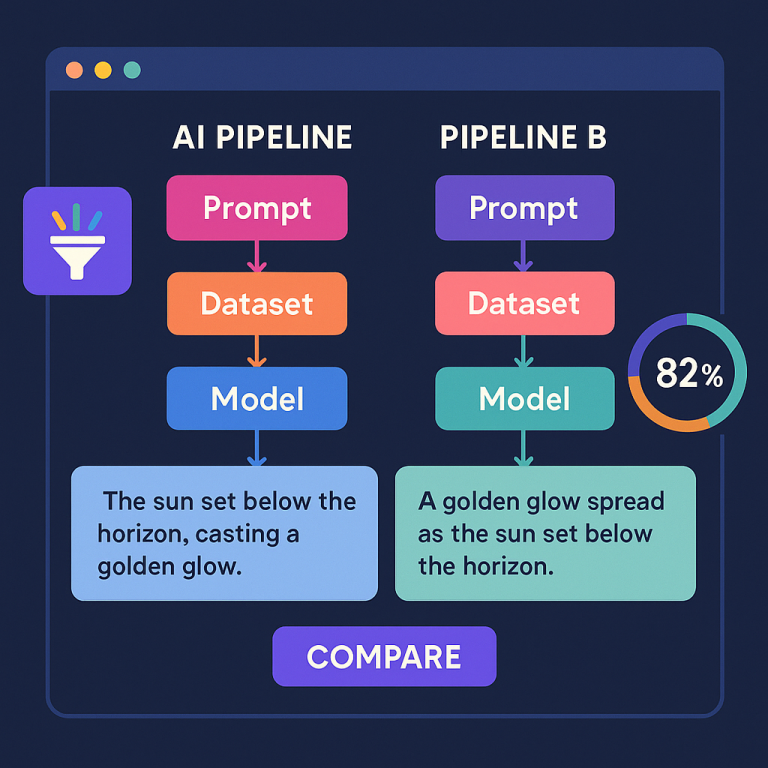
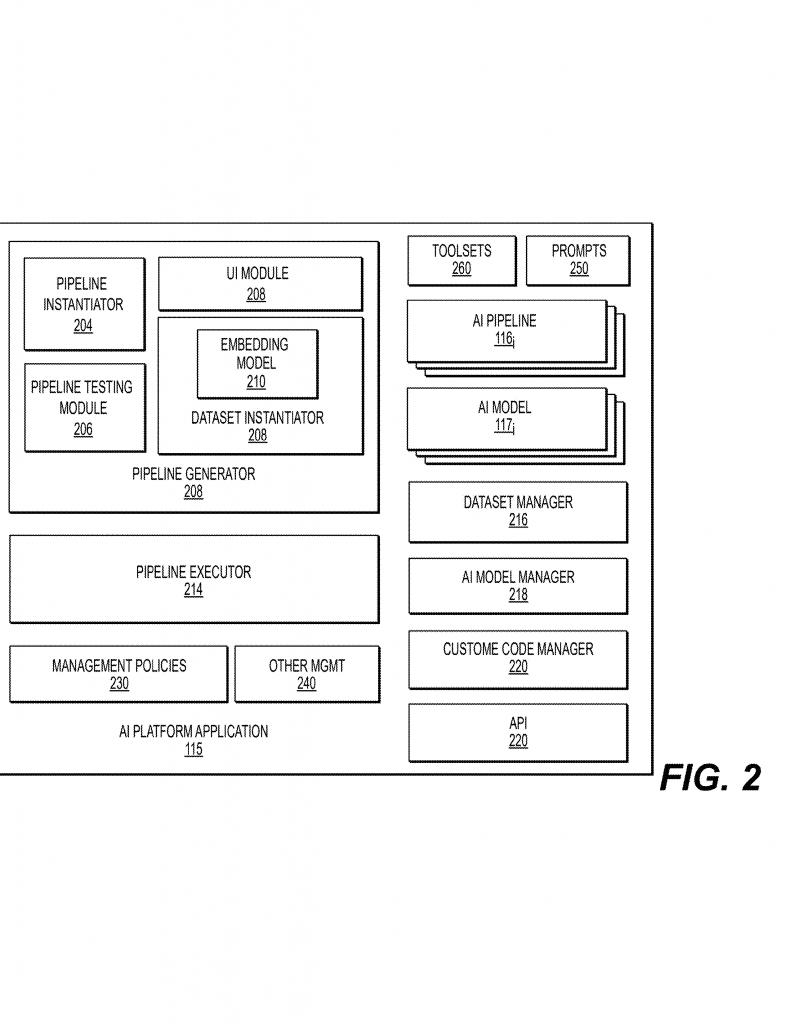
The platform lets users choose or create an AI pipeline. Each pipeline has building blocks: a dataset, an AI model, a package of prompts, maybe some custom code. You can duplicate a pipeline, change one part (like using a new model or prompt), and see both pipelines on the same screen. The pipelines are shown as flowcharts—boxes and arrows that make it easy to understand what’s happening at each step.
2. Simultaneous Testing
Once you have two or more pipelines ready, you can run them at the same time. You give them the same input—a question, a batch of questions, or even a conversation. The pipelines process the input and return their results. These results show up side by side on the screen, so you can instantly see what’s different.
3. Smart Comparison Using AI
This is where things get clever. The platform doesn’t just check if the outputs look the same. It uses another AI model (an embedding model or a language model) to measure how close the meanings are. This is called “semantic similarity.” For example, if one pipeline says “The sky is blue” and the other says “Blue is the color of the sky,” the platform sees that the meaning is the same, even if the words are different.
If the meanings start to drift apart—say, one pipeline gives a very different answer—the platform highlights where that happens. If you’re running a series of queries (like in a chatbot conversation), you can see exactly at which step the two pipelines start to disagree.
4. Historical Comparisons
The platform also lets you compare a current pipeline with past runs. This is useful if you want to check if today’s model is acting differently from last week’s, or if an outside provider changed something without telling you. The system keeps track of historical outputs, so you can run the same inputs and see if the answers have changed.
5. Rephrasing Queries for Better Testing
Sometimes, if the pipelines give very different answers, the platform can use a language model to rephrase the next question in a way that tries to keep the results closer in meaning. This helps you test if a small prompt tweak can fix a drifting pipeline.
6. Multiple Pipelines, Real Metrics
You’re not limited to just two pipelines. You can add three or more, and test them all at once. You can also see important numbers—how long each pipeline takes, how many tokens or resources they use, and even how much each run might cost. This is all shown on the same screen for direct, easy comparison.
7. Administrative Controls and Cost Tracking
For companies, the system includes tools for managing who can use which pipelines, what data is used, and for tracking costs. The platform can automatically pick cheaper options if the results are similar, or alert you if a pipeline starts costing too much. There are also controls to make sure sensitive data isn’t sent to outside AI models without permission.
8. Visual, Interactive Interface
Everything happens in a clear, visual interface. You can drag and drop blocks to build pipelines, see boxes and arrows that show the flow, and get instant feedback when you run tests. If something doesn’t match up, the platform suggests fixes or highlights the problem step.
9. Marketplace and Extensibility
The system supports a marketplace where users or third parties can upload and share pipeline parts—like new models, datasets, or code snippets. This makes it easier to build and test new solutions without starting from scratch.
10. Real-World Use Cases
This platform helps in many ways. For example:
- A business can safely test a cheaper AI model before switching, making sure the results stay good enough.
- A developer can debug a broken pipeline by seeing exactly where answers start to go wrong.
- A company can catch sneaky changes from outside providers that might affect their users.
- Anyone can save time and money by quickly comparing different setups, without writing extra code.
All these features work together to make AI development and maintenance faster, safer, and more reliable. By focusing on side-by-side testing, semantic comparison, history tracking, and real metrics, the invention gives both experts and beginners the tools they need to build better AI systems.
Conclusion
This patent offers a new way to test, compare, and trust AI pipelines. It helps users see not just if results are different, but if those differences matter. By putting everything on one screen—pipelines, results, meaning checks, and costs—it takes much of the guesswork out of AI development. For companies, this means more control, faster innovation, and fewer surprises. For everyone, it means AI that’s easier to understand and trust.
As AI becomes even more central to our lives and businesses, tools like this will be key. They help us keep up with the pace of change, make smart choices, and avoid costly mistakes. If you build or use AI, this platform could soon become one of your most important tools.
Click here https://ppubs.uspto.gov/pubwebapp/ and search 20250363040.