AI System Optimizes Deep Learning Performance and Cuts Costs With Smarter, Adaptive Resource Management
Invented by Galvin; Brian
Artificial intelligence is moving fast. But as AI models get bigger and more complex, we run into new challenges. How can we make these networks smarter, faster, and more efficient? A new patent application proposes a fresh way to design deep learning systems. In this article, we’ll break down the main ideas behind this patent, explain what makes it special, and help you see how this could shape the future of AI.
Background and Market Context
Today, AI is everywhere. Smart assistants, self-driving cars, image search, and chatbots all use deep learning. These systems are made up of many layers of artificial “neurons” that learn to spot patterns in data. For example, a deep learning network might learn to tell the difference between dogs and cats in photos, or predict the next word in a sentence.
As the use of AI has grown, so has the size of these networks. Modern models can have billions of connections. Examples include OpenAI’s GPT series or Google’s BERT for language, and many others for images, audio, and time series data. These large models are powerful, but they also come with big problems:
First, they need a lot of computer power. Training and running these models uses expensive hardware and large amounts of electricity. Second, most networks are set up to treat all data the same way, even if some parts of the data are more important than others. This means they waste resources on less useful information. Third, if the world changes or the data shifts, traditional networks are slow to adjust. Most changes to the network’s structure only happen during training, not when the model is running. This can lead to models that are slow to react or become less accurate over time.
To overcome these challenges, researchers and businesses are looking for ways to make AI more adaptive. They want systems that can change on the fly, use resources wisely, and keep working well as things change around them. This is true not just in big data centers, but also on devices like phones, cameras, cars, and other smart gadgets where computer resources are limited.
The patent discussed here targets these exact problems. It offers a system that can monitor itself, change its own structure, and focus its “brainpower” where it really matters, all in real time. With this, AI could become much more efficient, flexible, and reliable—key advantages in a crowded and fast-moving market.
Scientific Rationale and Prior Art
To understand why this invention matters, let’s look at how deep learning has worked until now and what is missing.
Most deep learning networks today are built with a fixed structure. They have a set number of layers and connections, chosen by the designers before training. Once the network is trained, its structure stays the same. Even if some parts of the network are rarely used or some types of data become more important, the network does not adapt. This leads to wasted resources.
There are some known techniques to trim down networks. One is called “pruning,” where parts of the network that are not used much are removed. This makes the network smaller and faster. However, pruning is usually done after training, not while the network is running. Also, decisions about what to prune are often made using simple rules, not by looking at the network’s real-time needs.
Another idea is “attention” mechanisms, like those used in Transformer models. These allow the network to focus more on parts of the data that seem important at each step. But again, attention is just one layer in the network and does not change the overall structure or resource use of the network itself.
There are also some attempts to monitor networks with special “supervisory” units or to use meta-learning (learning about learning). But these are usually simple, such as using extra models to spot errors or guide training. Few systems have built-in, multi-level supervision that can make structural changes during operation.
Finally, most networks allocate computer power evenly. They do not have a way to prioritize the most important signals or patterns, or to “bid” for resources based on usefulness. This means a lot of energy is spent on less helpful parts of the data.
The patent application here brings together several ideas in a new way:
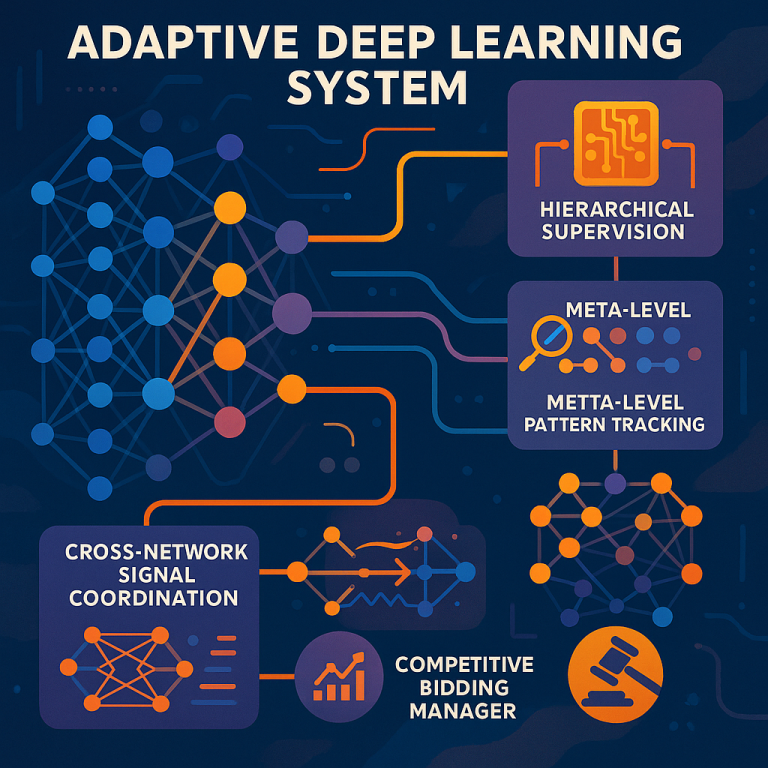
– It uses multiple levels of supervision (hierarchical), not just one, to monitor and adjust the network.
– It tracks not just network activity, but also the behavior of the supervisors themselves (meta-supervision), learning what kinds of changes work best.
– It opens up new, direct communication lines between far-apart parts of the network for faster and more flexible data flow.
– It introduces a “greedy” system where only the most useful patterns get priority access to computer resources, using a kind of competitive bidding.
– All of this happens in real time, not just during offline training.
No existing system combines all these features for real-time, adaptive operation. That makes this invention a big step forward over prior art.
Invention Description and Key Innovations
Let’s break down how this system works and what makes it unique.
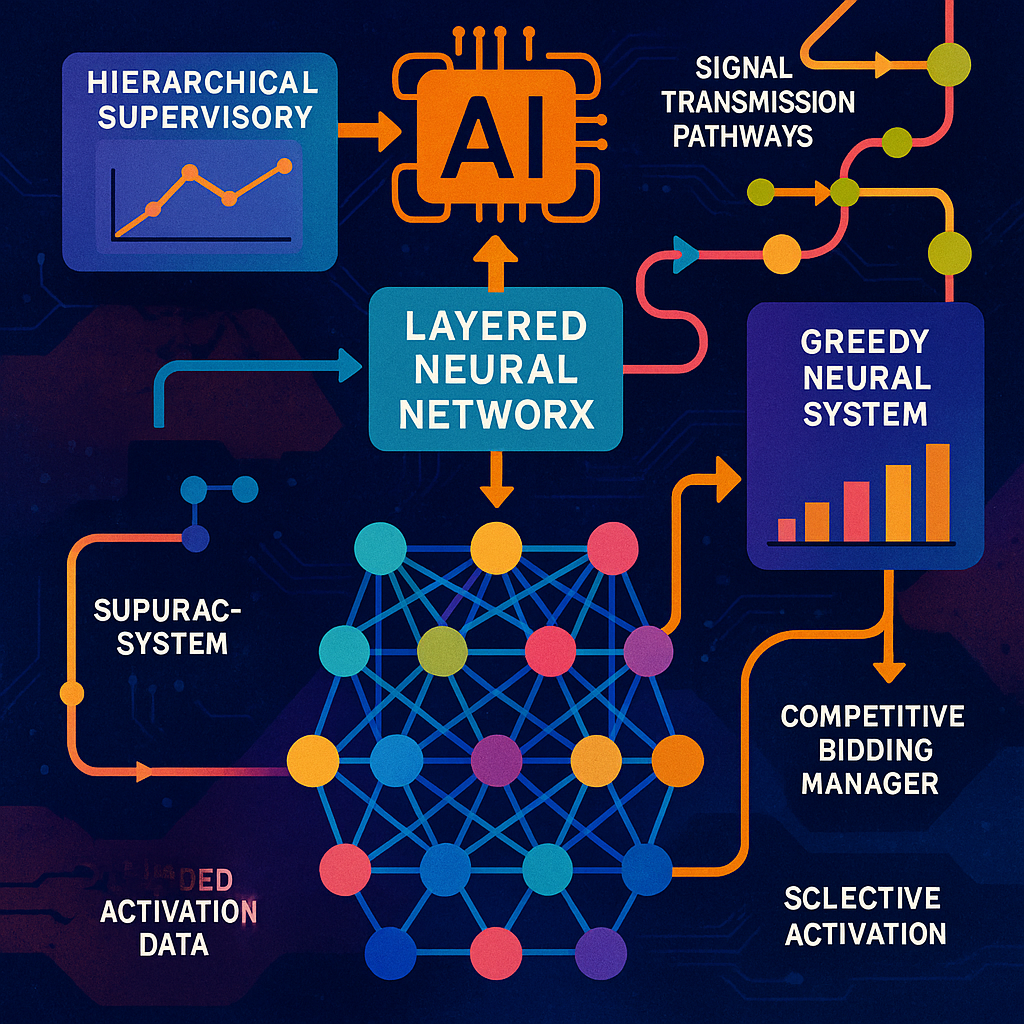
1. Hierarchical Supervisory System
Think of the network as a big city. In most cities, you have local police watching neighborhoods, city managers overseeing districts, and a mayor running the whole city. This invention uses a similar idea for AI networks.
At the lowest level, small groups of neurons are watched by “supervisory neurons.” These units collect data about how active each part of the network is, spot patterns, and look for places that are not working well. If a local area is not busy enough (like a quiet street), the supervisor can suggest trimming it down or changing how it connects to the rest of the network.
Above these, there are mid-level and high-level supervisors that watch over bigger regions and coordinate changes. This makes sure that any changes in one neighborhood fit with what’s happening in the rest of the city. If a big event is coming, the higher-level supervisors can shift resources or even reverse changes if problems show up.
This multi-level system means the network can adapt both locally and globally, improving speed, efficiency, and stability.
2. Meta-Supervisory System
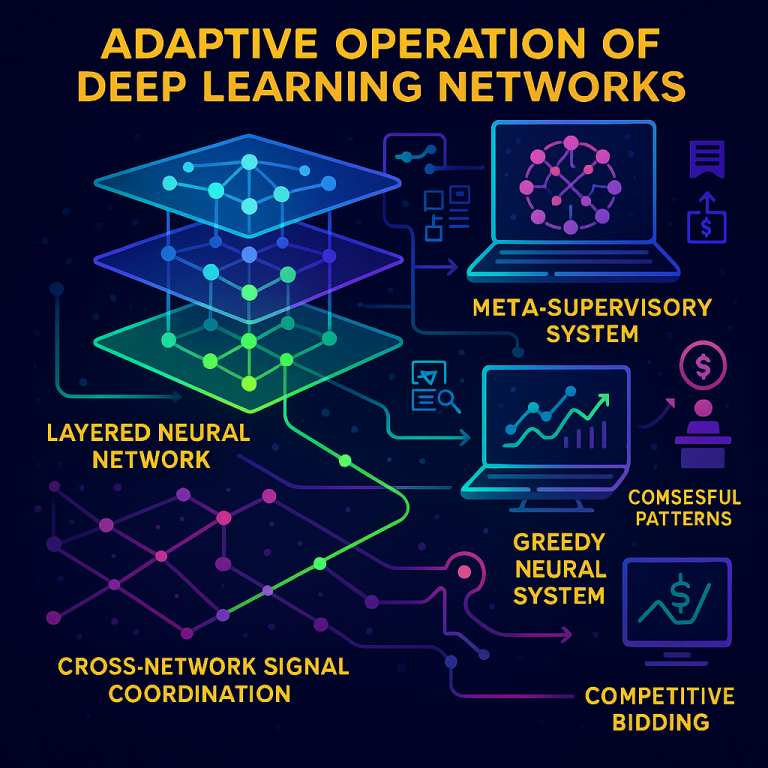
The next big step is meta-supervision. This is like having a city historian or strategist who keeps track of every decision made by the supervisors and how those decisions turned out. Over time, the system learns which changes worked well and which didn’t, storing this knowledge as patterns or “principles.”
When a new situation comes up, the meta-supervisor looks for similar cases from the past and applies lessons learned. This allows the whole AI system to get better at adapting, not just reacting. It also helps keep the network stable, avoiding mistakes that might slow down or break the system.
3. Dynamic Signal Transmission Pathways
Traditional networks have fixed paths for data to travel. If two distant regions in the network need to “talk,” the signal has to go through many layers, slowing things down. This invention adds the ability to create direct “shortcuts” between far-apart regions when needed.
Imagine an express train line added between two suburbs during rush hour. These new pathways can be set up or taken down as needed, and their strength adjusted based on how well they work. This makes the network much more flexible and able to respond quickly to new patterns or urgent tasks.
4. Greedy Neural System with Competitive Bidding
Perhaps the most novel part of the invention is the “greedy” neural system. Here, not every signal gets treated the same. Instead, each activation pattern (a burst of activity in part of the network) is scored using simple measures: is it new? Is it strong? Does it match key performance goals?
Patterns with the highest scores are allowed to “bid” for limited computing resources, like memory or processing time. The system can use different ways to pick winners, making sure not to miss rare but important patterns. There are also checks to make sure no part of the network is starved of resources for too long.
This is like an auction where only the most important jobs get the best workers, and less important jobs are put on hold. Over time, the system learns which kinds of patterns lead to the best results and adjusts how it scores and allocates resources.
5. Real-Time Pruning and Recovery
The system doesn’t just change itself during training. It can prune (remove) unused parts or add new connections while running, based on current needs. If a change doesn’t work out, temporary support paths allow for quick reversal, keeping the network stable.
This means the AI can “grow” or “shrink” as needed, without stopping for retraining. It’s like a city that can quickly open or close roads and buildings depending on traffic, emergencies, or special events.
6. Anomaly Detection and Intervention
The greedy neural system also watches for odd or unexpected patterns. If a sudden change or problem is spotted, the system can react fast—rerouting data, changing outputs, or alerting human operators. These interventions are designed to fix problems without causing bigger disruptions.
7. Historical Buffering and Pattern Synthesis
The invention keeps a buffer of valuable patterns over time, allowing it to look back and combine old and new information. This helps the system spot trends, recognize repeating problems, or make better predictions. By synthesizing data from different regions and time periods, the AI becomes more robust and insightful.
8. Feedback Learning for Continuous Improvement
Finally, the system constantly tracks the results of its decisions. Did giving more resources to a certain pattern help? Did pruning a region improve speed? Using this feedback, the AI tunes its own settings for scoring, bidding, and intervention, getting smarter with every cycle.
Why This Matters
This invention offers a complete toolkit for adaptive, resource-smart AI. It goes beyond simple monitoring or one-time pruning. Instead, it provides a living, breathing network that can:
– Watch itself and learn from experience
– Restructure on the fly to meet new challenges
– Focus on what matters most at every moment
– Stay stable and reliable even as it changes
– Recover from mistakes quickly
– Work efficiently, saving power and hardware costs
For businesses and researchers, this means faster, leaner, and more reliable AI. It can unlock new uses for AI in fields where resources are tight or conditions change quickly—like edge devices, robotics, finance, medicine, and more.
Conclusion
AI is growing up, and so are the challenges it faces. The patent application we explored here introduces a bold new way to make deep learning networks more adaptive, efficient, and reliable. By combining hierarchical supervision, meta-level learning, dynamic communication, and a value-driven bidding system, this invention promises to make AI systems that are not just bigger, but smarter and more responsive.
The future of AI will not be about who has the biggest network, but who can use resources wisely, adapt quickly, and keep learning on the go. This invention shows one path to get there—and it could change how we build and use AI for years to come.
Click here https://ppubs.uspto.gov/pubwebapp/ and search 20250363365.