Effortlessly Sync Virtual Machine Data Across Storage Systems for Reliable Enterprise Continuity
Invented by DOUCETTE; DANIEL, HOSTERMAN; CODY, COLGROVE; JOHN, GENEREUX; NEALE
In today’s world, keeping data safe and always available is a big challenge. As companies use more virtual machines and move to the cloud, old ways of protecting data are not enough. This article explores a new patent application for making sure data is always copied and ready across different storage systems using virtual volumes and smart replication. We’ll break down why this matters, how it works, and what makes this invention special.
Background and Market Context
To understand why this invention is important, let’s look at how businesses use computers and storage today. Most companies do not just have one server or one place where they keep their important files. Instead, they use many computers, often as virtual machines, and store data across different places. These can be their own data centers or in the cloud.
Virtualization has changed how storage works. With virtual machines, you can run many systems on a single piece of hardware. But this also means your storage needs to be smarter. It must keep up with fast changes, move data quickly, and not lose information when something goes wrong.
Today, companies need their data to be:
- Available all the time: If a server fails, users still expect to get to their files.
- Protected from loss: If something breaks, there should be a copy of the data ready to go.
- Easy to manage: With so many virtual machines and storage systems, managing everything must be simple.
Cloud services and virtual machines make these needs even bigger. Companies want to move workloads from one place to another, sometimes in the middle of the day, without anyone noticing. If one part of the system fails, the rest should keep working. This is called “high availability.”
Traditional ways to protect data, like making backups every night or copying files only once in a while, are no longer enough. Modern businesses need their data copied right away, all the time, across different systems. This is called “synchronous replication.” It means every change is written to more than one place at the same time, so there is never a gap.
But with so many virtual machines and storage systems, it can be hard to make sure all the data is copied correctly and is always available. This is where the new invention comes in. It promises to make synchronous replication easier, smarter, and more automatic, especially for environments full of virtual machines and cloud storage.
Scientific Rationale and Prior Art
To see why this new approach is special, let’s look at how things have worked before and what problems there have been.
In the past, most storage systems were simple. You had a server and it wrote data to a disk. If you wanted a backup, you would copy the data to another disk, maybe once a day. If you wanted to be extra safe, you might use RAID, which writes data to several disks at the same time. But as companies grew, they needed more—like clusters of servers, virtual machines, and storage both in their own buildings and in the cloud.
Some older solutions for data protection include:
- Snapshots: These are quick pictures of data at a moment in time. If you delete or lose a file, you can go back to the last snapshot. But if your system fails right before a snapshot, you can lose data.
- Asynchronous replication: This copies data to another system, but not right away. There is usually a lag, which means some data can be lost if there is a sudden failure.
- Manual failover: If a storage system fails, an administrator must switch to the backup. This can take time and cause downtime.
Some newer solutions use synchronous replication. This means that every time data is written, it is written to two or more places at the same time. If one place fails, the other has the exact same data, with no lag or gap. But even with this, there are problems:
- Complex management: Setting up and managing replication policies for dozens or hundreds of virtual machines is hard work.
- Lack of virtualization support: Many systems are not built for virtual machines. They treat all data the same, which can make things slow or hard to track.
- Limited automation: If a path fails (for example, if a network cable is unplugged), switching to the backup system is not always automatic or may require manual steps.
Some storage systems have tried to support virtualization better, such as by using APIs (ways for software to talk to each other) like VMware’s VASA. This helps link virtual machines with storage, but managing replication and failover is still tricky.
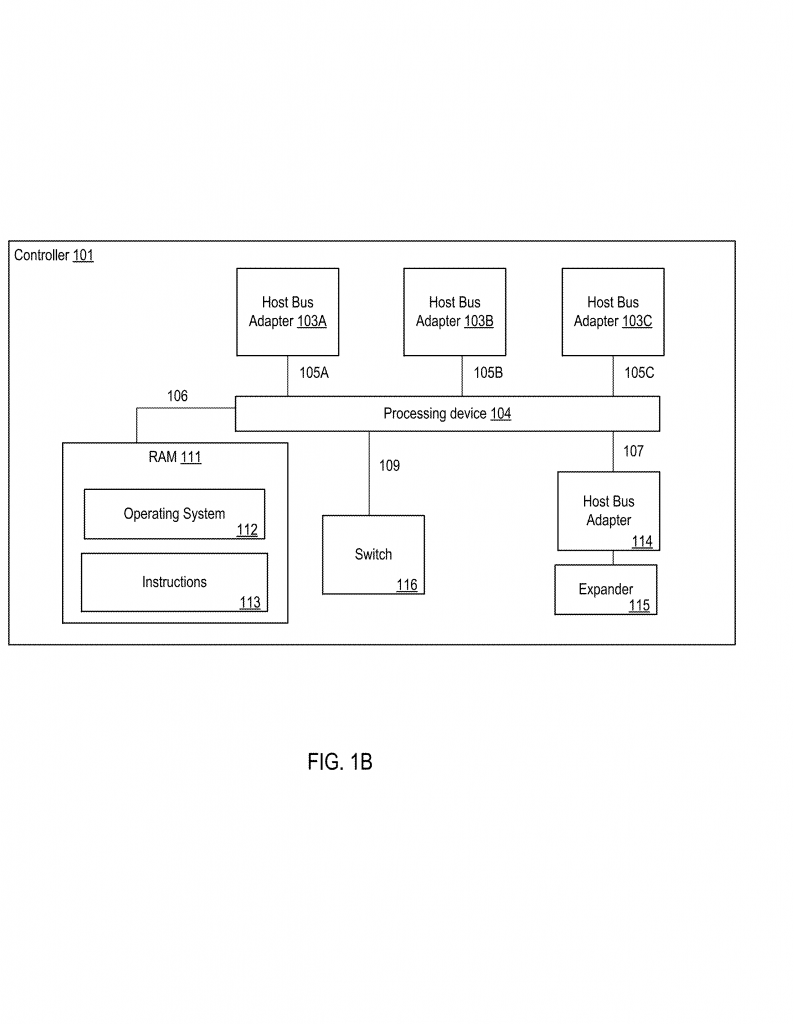
There have also been attempts to use “stateless” methods, so that if a controller (the brain of the storage system) fails, another can take over without losing track of which data is most up to date. Even so, these systems often require special hardware or careful manual setup. They may not offer seamless, automatic failover for virtual machines with active workloads.
This is where the new patent application comes in. It aims to fill these gaps by combining automatic, synchronous replication with easy-to-use management for virtual volumes. It also promises to make failover seamless and automatic, so that virtual machines keep working even if something goes wrong behind the scenes.
Invention Description and Key Innovations
Now let’s look at what this invention does differently and how it works.
At its core, the invention is about managing virtual volume datastores—special storage areas for virtual machines—across two or more storage systems, copying every change instantly to keep the data always available. Here’s how it works, step by step:
1. Assigning Virtual Volume Datastores to a Pod
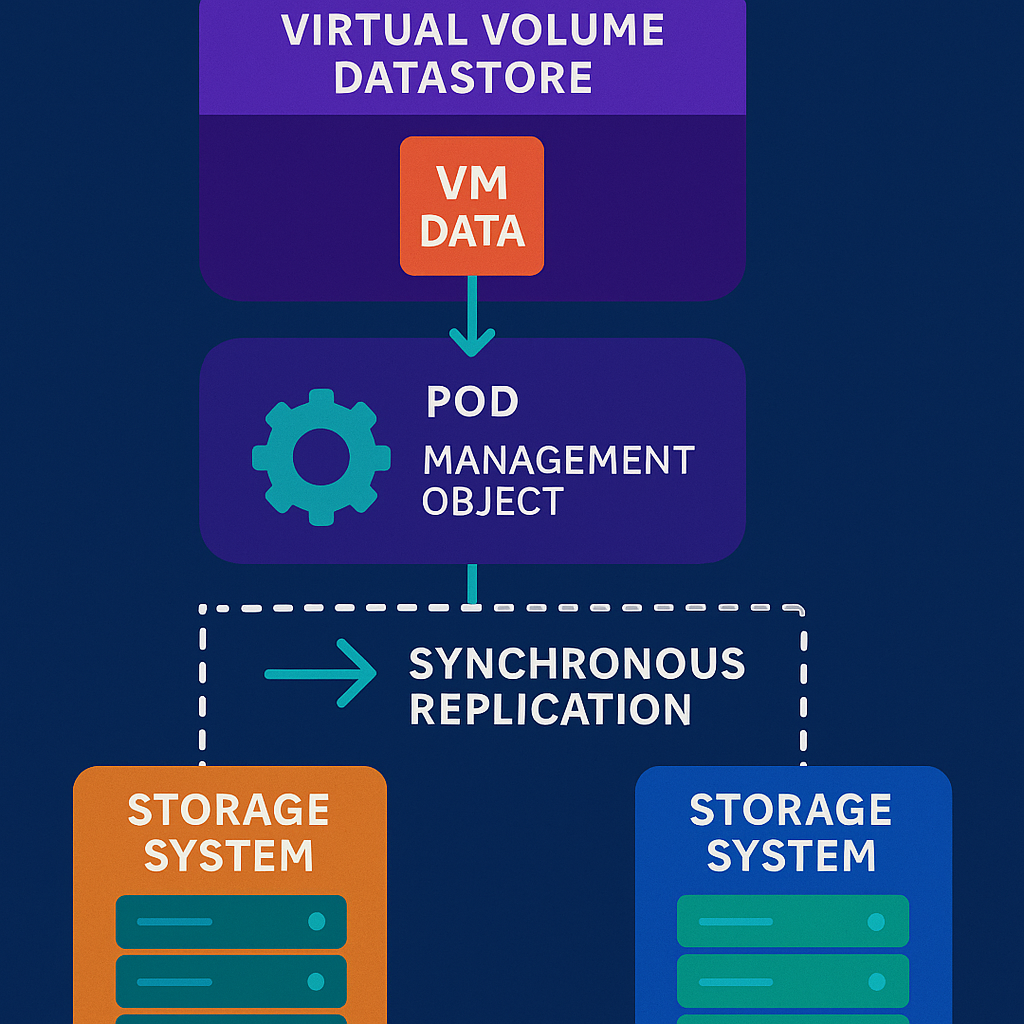
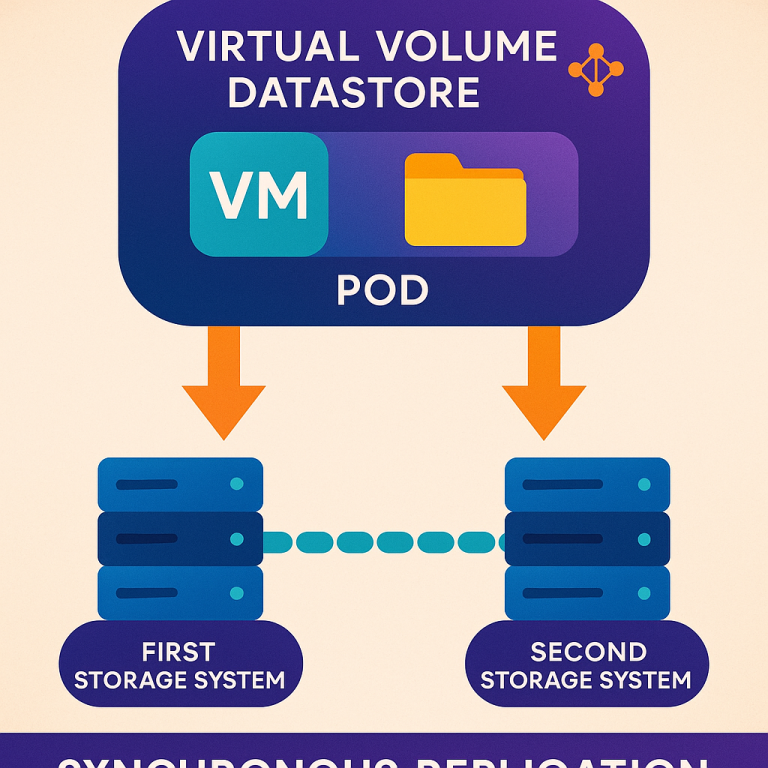
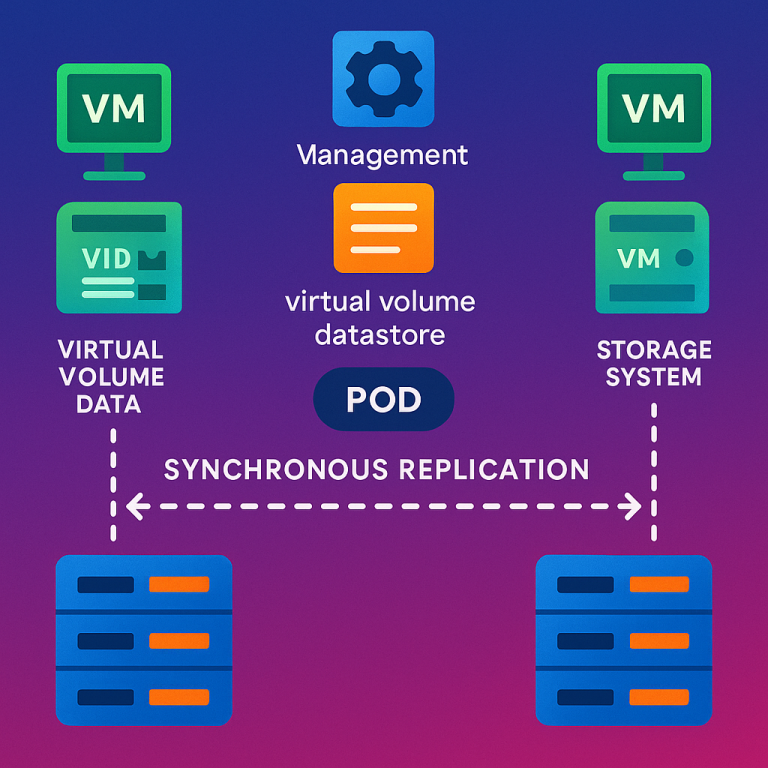
The invention starts by letting an administrator set up a “pod.” A pod is a kind of management group that contains a first storage system (where the data lives to start with) and a second storage system (where the data will be copied to). The administrator can pick a policy that says, “I want this virtual volume to be synchronously replicated to this other system.”
2. Synchronous Replication of Data
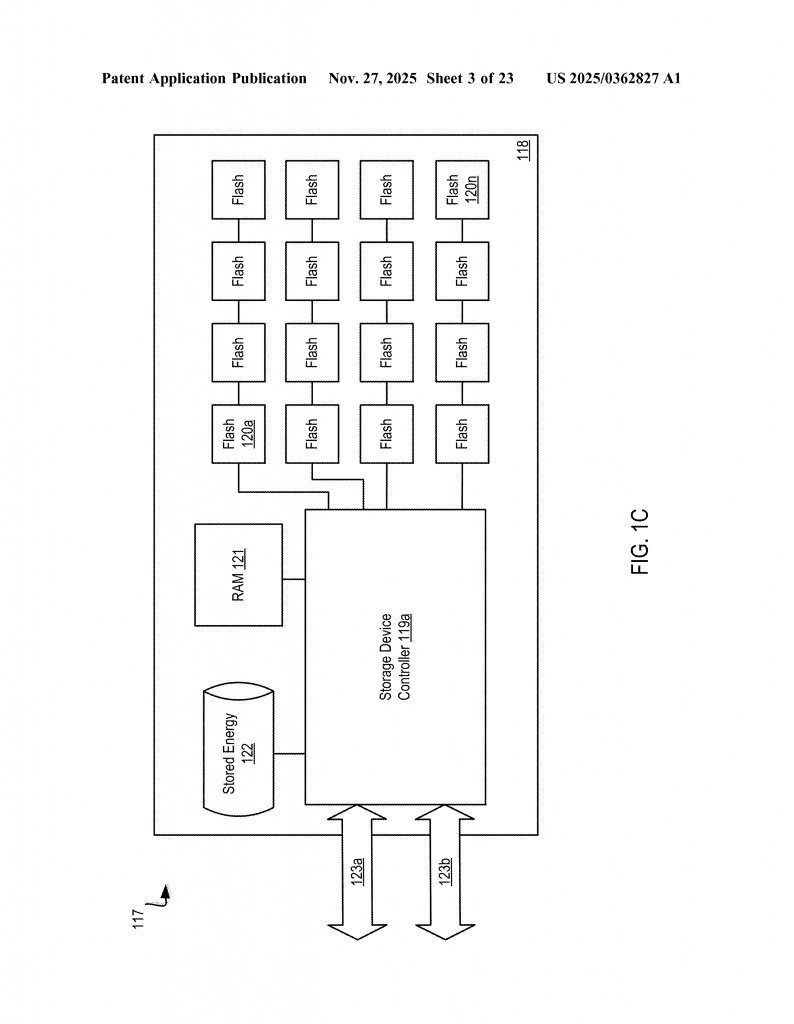
Whenever a virtual machine writes data to its virtual volume, that data is written to both the first and second storage systems at the same time. This means there is no lag—both systems always have the exact same data. The set of virtual volumes can be accessed by the virtual machine through either system.
3. Metadata-Driven Management
Each virtual volume is tagged with metadata that marks it as part of the virtual volume datastore and tracks its status. This metadata is stored in the storage arrays themselves, not just in the controllers or software, making recovery and migration easier.
4. Protocol Endpoints and Path Management
The system sets up protocol endpoints—special connections that let virtual machines talk to the virtual volume datastore. There is an endpoint on both the main and backup storage systems. The virtual machine can use either one, and if one path goes down (for example, due to a network issue), the system automatically switches to the other path with no interruption.
5. Automatic Failover
If the first storage system becomes unavailable, the invention automatically fails over access to the second storage system. The virtual machine keeps running, with no manual steps needed and no data loss.
6. Flexible Data Types
The virtual volume datastore can include all types of virtual machine data: virtual disks, configuration files, and file systems. This makes it flexible and suitable for many different applications and workloads.
7. Stateless API Providers
The controllers that manage the virtual volumes do not store any state about the volumes themselves. Instead, all information is stored as metadata in the arrays. This means that controllers can be replaced or upgraded with no risk of losing track of the data.
8. Seamless Migration and Provisioning
New virtual machines can be created from the virtual volume datastore on any storage system in the pod, and all data is automatically replicated across systems. Existing virtual machines can be moved into or out of the pod, and snapshots (copies of the VM at a specific time) are also synchronously replicated.
9. Support for Cloud and Hybrid Environments
The invention is designed to work not just in on-premises systems but also in cloud or hybrid setups. You can stretch a pod across multiple locations, whether they are in your own data center or in the cloud.
10. Simple, Unified Management
All of these features are managed through APIs and software tools, making it much easier for administrators to set up, monitor, and adjust replication policies, failover, and data migration.
These key innovations make the system much more robust, flexible, and easy to use compared to older systems. Any write or change made by a virtual machine is instantly and safely stored in two places, and if a failure happens, virtual machines keep running with no interruption.
Conclusion
This new invention marks a big step forward in how companies can protect their data in a world of virtual machines and cloud computing. By making synchronous replication easy and automatic, and by linking it closely with virtual machine storage, it ensures that data is always safe, always available, and always ready—even if something goes wrong in the background.
The clever use of pods, metadata, protocol endpoints, and stateless management means administrators can spend less time worrying about complex setups and more time focusing on what matters to their business. With built-in support for failover, snapshots, and seamless migration, this approach sets a new standard for high-availability storage in virtualized environments.
For anyone running virtual machines—whether in their own data center, in the cloud, or in both—this invention offers a simple, strong, and future-proof way to keep data safe and always within reach.
Click here https://ppubs.uspto.gov/pubwebapp/ and search 20250362827.